Author Archives: kevin

About kevin

I write the posts

What I’ve learned, past month or so, part 2

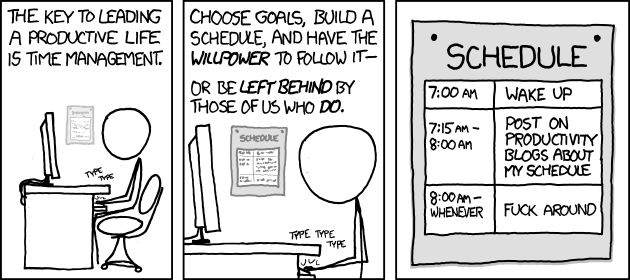
  • This XKCD comic about productivity is very funny and visualizes something I can see happening to a lot of people that talk about productivity. I have stopped trying to show off by blogging about productive techniques I use. I probably haven't stuck with any of them.
  • For me the most effective to do list is my brain, followed by the Notes app on my iPod, the most effective list size is "three" and the most effective time range is "right after class ends." Everything else works until I blog about it (about a week) and then I stop using it. I use Google Calendar for events and birthdays and news. I forget about 100% of events that I don't put in there.
  • I've stopped writing for the Forum. Most of the stuff I had to say fell into the category of "intelligently defend an unpopular position, and/or show off my way of looking at the world." The goal is probably to show other CMCers how wrong they are, and I've realized I don't really want to do that.
  • I was one of four students invited to talk at Idea Night at the Ath. I spent most of the day thinking about the topic and what I should say, and got really nervous about it. But I totally misread which part of the talk would be hard. I was worried about saying intelligent things for 12 minutes, but I should have worried more about entertaining the audience. I went in thinking "I am speaking at the Athenaeum, so like most Ath speakers I'll mimic an academic person." I gave a really academic sounding talk about financial models. But what I should have thought was "I am speaking to other students so I should be funny." Instead I gave a really boring talk and finished in last place. I also violated my Forum no-writing rule and picked a unpopular position - bashing the finance industry when there are a ton of students from CMC that go into finance. The winner totally understood the audience and gave a talk about how the US should invade Canada. The lesson is to place less importance on the venue and more importance on the audience.
  • Last month my dad wanted me to take a chance on something and he vigorously encouraged me to do it. The value of the thing was obvious to me even without the encouragement, but I never got around to doing it. I think it has to do with who owns the credit if it turns out well. When you want to motivate someone to do something, if you can let them own the idea, they're probably more likely to do it. Otherwise what's their incentive? If they do it and it turns out well you take all the credit. On the other hand they might not put two and two together, so you might have to wait a long time. So if I'm coaching this summer I'll try to experiment with different approaches to encouraging people to do things they haven't tried before, like dribble with their left hand.
  • In startups everyone says you want to build the Minimum Viable Product (MVP) - the smallest possible complete product - to start getting feedback from users, and to avoid building a perfect product which no one wants. When people say this I've nodded my head vigorously, but now I have a product that I've been making ridiculous excuses to not launch - "it'll cost me money, I need feature X and feature Y, etc." When Good Morning CMC started it looked like this: So I need to just launch it.
  • I need some sort of MVP rule for emails. Sometimes I get caught up in "I need to send this person the perfect email," and I never send it. I need some sort of rule like "whatever's in your drafts folder at 5pm will automatically be sent to the recipient" to force me to actually send the damn email. This is in line with my semester goal of taking more low-cost, high-value opportunities. A lot of times the biggest obstacle to pursuing those is myself.
  • I've started charging money for ads on top of Good Morning CMC. The minute after I got my first $5 payment in Google Checkout I said "duh, why haven't I done this since day 1?" So that's something to keep in mind for the future - I'm likely to regret not charging for something, and in addition I'll make more money and possibly earn more respect with a paid product than a free one.

Liked what you read? I am available for hire.

links for 2011-03-21

Liked what you read? I am available for hire.

What I’ve learned last month or so, part 1

  • I used Java to implement algorithms like Floyd Warshall, max-heap, Ford-Fulkerson and others, for the ICPC competition. This involves writing mostly for-loops, arrays, some lists and maybe 1 level of inheritance. I don't *know* Java, in the sense that I've never used any of the stuff that *makes* it Java.
  • For that matter, there's a lot of stuff I don't know. As I've been reading in my favorite new book, Coders at Work, you could research the details behind something like how the text you're reading appears on the screen to an almost infinite level of detail. For example, this text is in an HTML document which is formatted with CSS. But the HTML doc doesn't exist anywhere - it's dynamically generated by WordPress and PHP. Your browser contains instructions on how to display HTML/CSS and it's written in C, or C++. But it has to run on the operating system, which is UNIX, Linux or Windows, and each of those has its own windowing system and programming hooks. Finally the operating system has to divide time between all the applications currently running, figure out which one of them is "foremost" and display it on the screen, which is a piece of hardware requiring a special set of instructions from the operating system. And even that's missing a whole lot of obvious places to dive in for at least a few months on things like font rendering, multithreading, sending bits over a wire with HTTP, serving requests with Apache, and more.
  • One thing people say about technically skilled college graduates is that they can learn a ton and double their value in the first few years out of college, because you are programming all day and learning from the best in the industry. The other thing people say about startups is that when you work at a startup you might have to do everything and learn crazy new things from scratch all the time. I learn quickly but it's hard to show that to a company, or at least to disting. So you have to try to learn at your slow pace, or try to start a company yourself to learn at a fast pace, and then get into a startup.
  • I talked about this with Nick Bergson-Shilock from Hackruiter yesterday. Nick agreed there's a chicken and egg problem where people expect you to have a ton of skills but the way you learn those is to go work at a startup. I thought it would be cool to have some sort of online tool for learning how to scale your site, and survive things like a sudden giant burst of traffic, data writes etc. So I'll look into writing an app to do that.
  • I am trying to hire for Good Morning CMC. Hiring is really difficult. I'm pretty lazy, so for something like Good Morning CMC there are a few different scripts to automate things like deploying to the server, sending out the Snack menu every night (it's entirely automated, I don't have to do anything) or creating the email (so I don't miss closing HTML tags, etc). These scripts are good and help keep me sane; if I didn't have them it would take upwards of 2 hours to put the email together every night. But at the same time it makes the project complex. It's a Catch-22 where the students who could figure out the whole system without any problems are probably the ones who have better things to do, while the students who are pretty far away from figuring it out would take 2 hours a night, and possibly get discouraged.
  • Mostly I just want someone to show initiative and do something like grab the source code, make a change and then upload it. Maybe that's not a good heuristic for a good candidate, but so far it hasn't happened.

Liked what you read? I am available for hire.

links for 2011-03-20

  • worth keeping in mind: "Parkinson shows how you can go in to the board of directors and
    get approval for building a multi-million or even billion dollar
    atomic power plant, but if you want to build a bike shed you will
    be tangled up in endless discussions.

    Parkinson explains that this is because an atomic plant is so vast,
    so expensive and so complicated that people cannot grasp it, and
    rather than try, they fall back on the assumption that somebody
    else checked all the details before it got this far."

  • sites that change their content based on the ipod/ipad/browser window size. inspirational
  • chart showing various different radiation doses.

Liked what you read? I am available for hire.

links for 2011-03-19

Liked what you read? I am available for hire.

links for 2011-03-17

Liked what you read? I am available for hire.

links for 2011-03-16

Liked what you read? I am available for hire.

links for 2011-03-15

Liked what you read? I am available for hire.

links for 2011-03-14

Liked what you read? I am available for hire.

The Apartment

Warning: contains spoilers. The Apartment is a classic movie about a pencil pusher who lets executives at his company use his apartment for trysts, in exchange for a fast-track up the corporate ladder. He falls in love with the current mistress of a company VP, who is, coincidentally, using his apartment to hook up with her. It's a tribute to the idea that you don't need a complex plot or special effects to produce a wonderful film. In my summary of Breakfast at Tiffany's last year, I noted that Audrey Hepburn's character only started to like George Peppard's character once he rejected her. In a slight twist, Shirley MacLaine's character only starts to like Jack Lemmon when he turns down the VP's request for his apartment, and quits his job instead. Which is, to be frank, the first alpha-male move he's made all movie. MacLaine leaves the VP and heads to his apartment. And then you get this scene, culminating in one of the most famous lines in moviedom: Lemmon throws away all of his alpha status by proclaiming his love for MacLaine. She's obviously aware of this, and also put off, which is why she tells him to "Shut up and deal." This is code-speak for "Stop cloying, if you keep it up I'm really going to regret my decision to be with you." This is reminiscent of an earlier scene in the movie, when Lemmon actually forgives MacLaine for standing him up, and MacLaine rebukes him for doing so. Total post-movie relationship time: Unless Lemmon starts acting like she should be grateful for the chance to date him, and not the other way around, I'd give it about a week. (As a side note, Fred MacMurray's character is a master of reframing. MacLaine attempts suicide after he doesn't show her enough affection, and in their first conversation after she recovers, he says something to the effect of, "How could you be so silly? You should apologize to me for giving me such a scare." Maybe 1% of guys would ever think to say that and 0.1% would have the guts to pull it off.) George Peppard-Jack-Lemmon role that you see in Breakfast at Tiffany's and The Apartment, where the cloying lead character gets the girl anyway, is not one that you see much nowadays.

Liked what you read? I am available for hire.