Walnut Creek's Design Review Commission is reviewing a new apartment building on Botelho Drive across from the Habit this evening. Like every project proposed in Walnut Creek recently, it cannot be built under the city's normal zoning code, so it is using state density bonus law to waive laws around heights and setbacks that make the project financially unworkable.
Like every other podium apartment proposed recently it feels like a giant missed opportunity. I hope the Design Review Commission - and the city - can spend a bit more time thinking about, and trying to remove, the constraints that make it hard to produce a building that families can live in.
As someone with two young kids it's always been notable, and odd, that Alma Park, up the hill, has no kids facilities - no swing, no playground, no basketball hoop. This would be a great chance to try to fix that. But the proposed building has no three or four bedroom units, and the interior courtyard is going to struggle to get sunlight. The lack of three+ bedroom units means that there are going to continue to be few product types available in Walnut Creek for families. It is hard for a lot of people to afford a $1.5m single family detached house but if that is the only living option available that offers three bedrooms then that will substantially constrain who can live here and hamper young couples ability to have children.
Most of the apartments have a window on just one side. The interior facing rooms on the lower floors are going to have a lot of trouble getting light in. With a window on only one side, you can't ventilate your apartment by opening windows on multiple sides. This increases the demand for HVAC, which increases the cost of living.
It's possible to do better - a lot better! In other countries, you very rarely
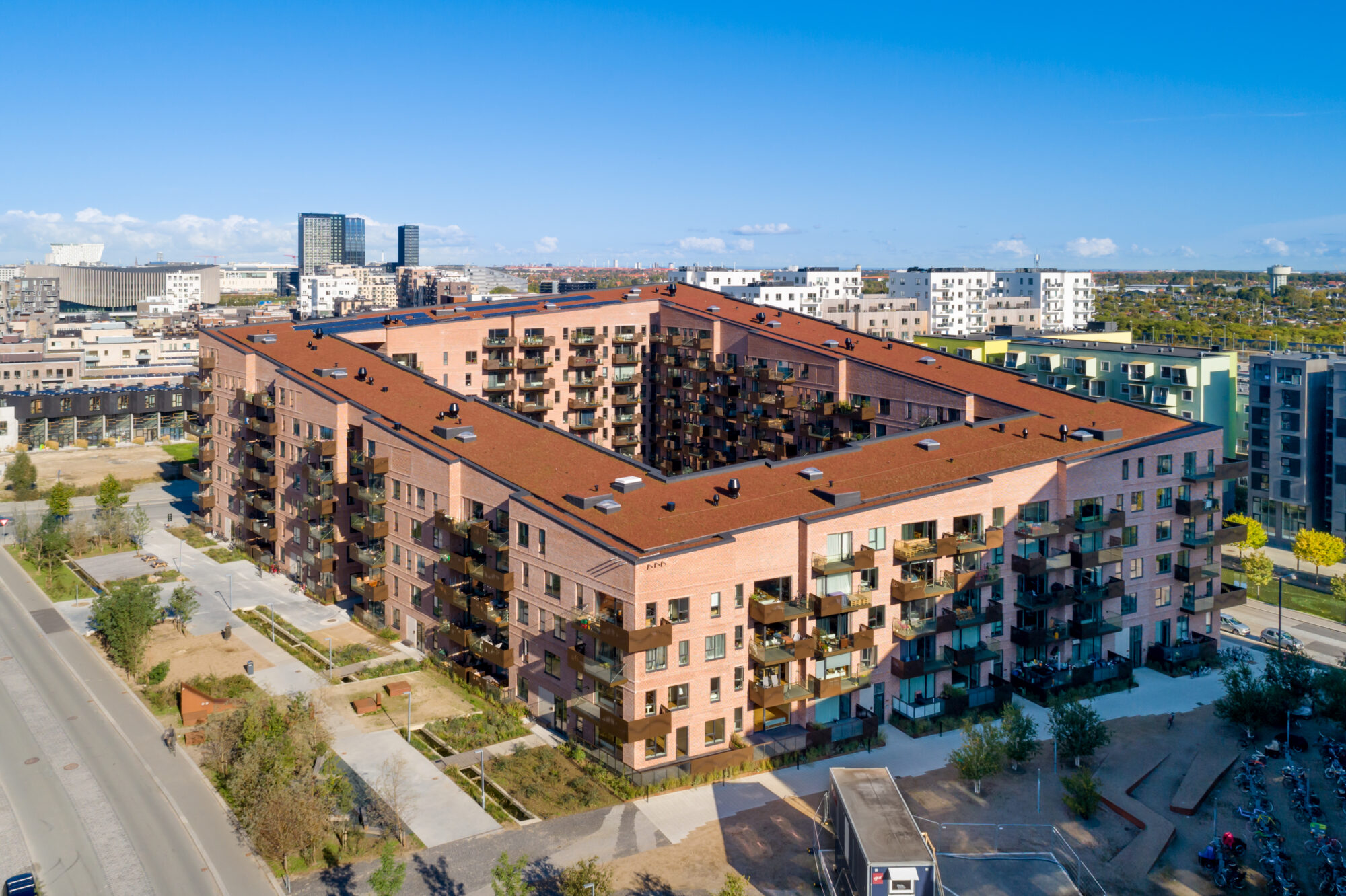
see this "double loaded corridor" design. Here's an apartment in Copenhagen,
Denmark that is actually denser (149 homes/acre) than this proposal, and the
same average height.
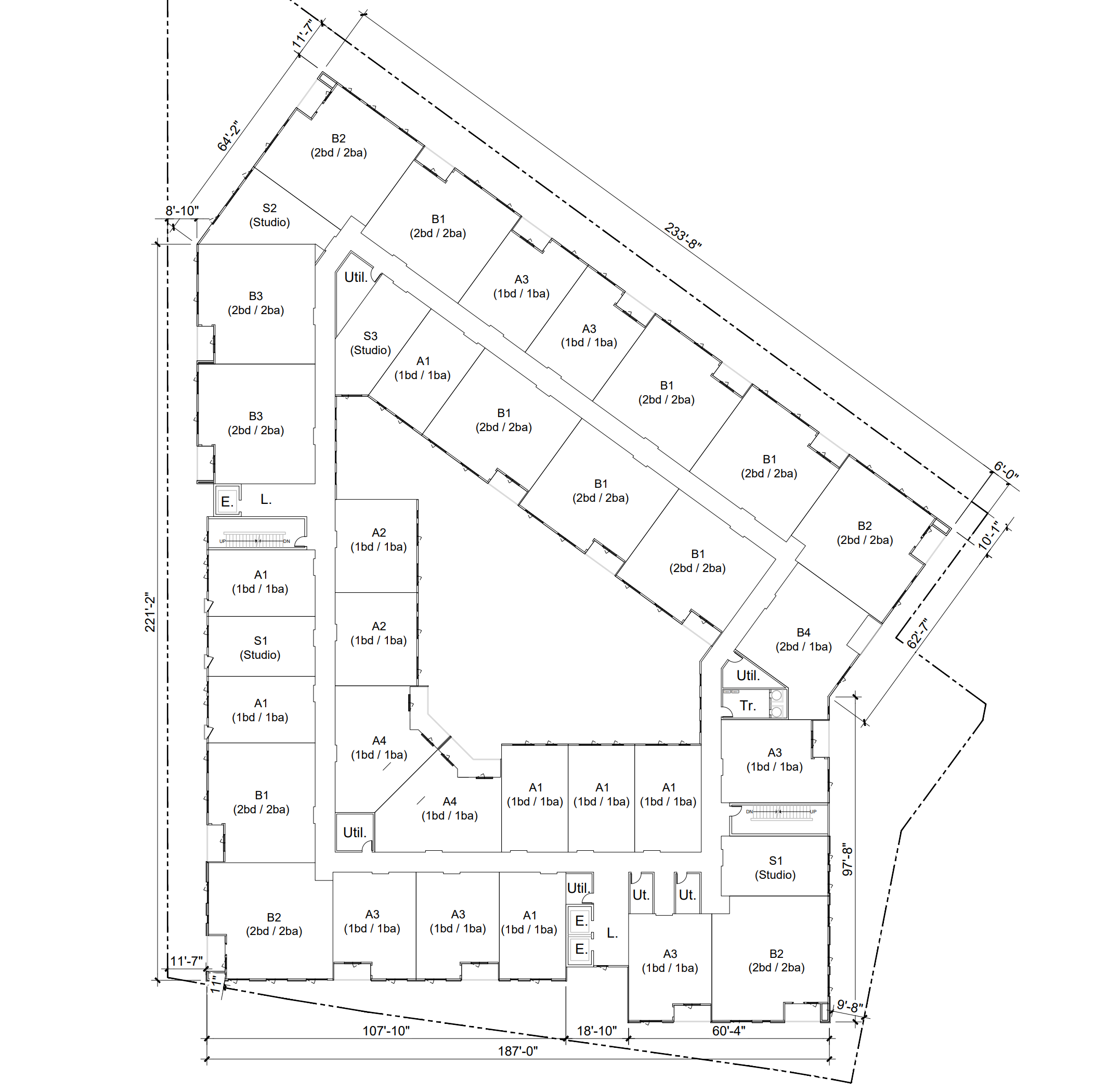
Look at this floor plan. Every apartment has windows on multiple sides and at least one balcony, sometimes two.
When you have windows on multiple sides it is a lot easier to offer units that
have lots of bedrooms. This project has tons of family sized apartments. And
when every room is multiple aspect you can do stuff like offer a 900 square foot
one bedroom unit.
The median household income here in Walnut Creek is $130,000 - more than double the median Copenhagen income - but there are zero 900 square foot one bedroom apartments here that have windows on multiple sides.
And when you don't need to dedicate as much interior space to circulation, you
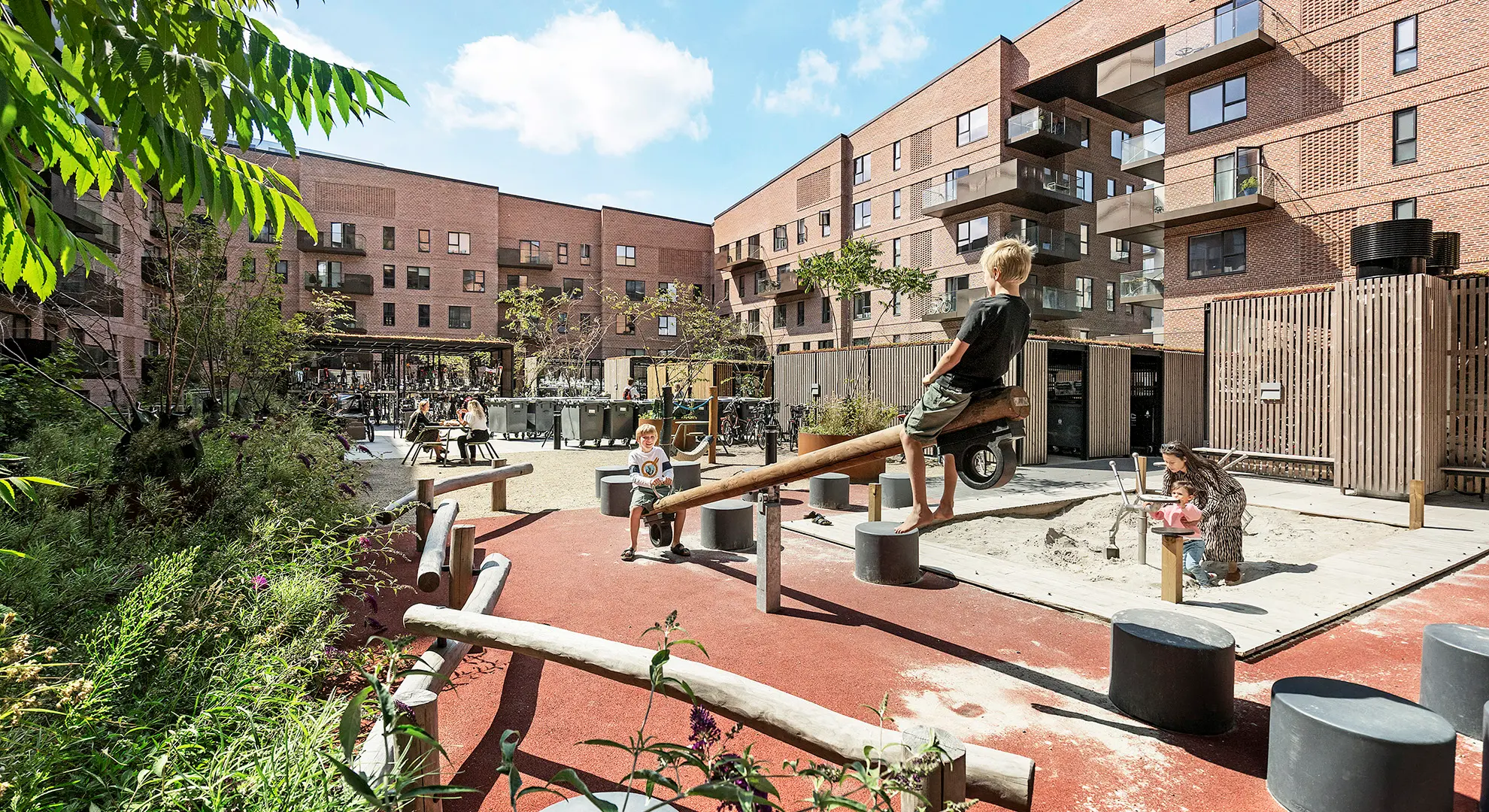
can have a sunlight filled interior courtyard. With a playground. Look how
much light there is on this playground! This is a building my family could live
in.
I really hope the city can spend some time thinking about why we can't design
apartments in Walnut Creek with four bedrooms and sunlight and courtyards that
have playgrounds in them. Here are some of the constraints:
Minimum parking: The parking requirements shape the whole design of the
building but parking is about to radically change forever. In five years it will
be possible to buy a car that can drop you off and then go park itself in an
offsite garage. The onsite parking in this building has maybe a ten year useful
life, in a building with a seventy five year lifespan. If we as a city were
willing to be more aggressive about offstreet parking and encouraging other
options - we could get much more livable buildings with cheaper rent.
Some neighbors have complained about the building height, and this is also
an answer for them. If we could cut the amount of space dedicated to parking
we could cut a floor off the building.
Parking standards: All of the city's rules about aisle widths and stall
widths and lengths assume a human is parking every car. A robot is capable of
parking cars with an inch of clearance on both sides. A self driven car cannot
block anyone in. "Humans park their own cars" will be true for maybe five more
years and for the next seventy years of this building's designed life, the
sixteen foot wide drive aisles, and nine foot wide parking stalls will age like
sour milk.
Maybe this building in 2026 can't assume robots are parking the cars. But we
could change the city's rules now and maybe a building a year from now will
be able to dedicate less space to parking.
The global leader in self driving cars has a headquarters thirty miles from
here - the city could invite someone from Waymo to give a talk on the future
of onsite parking and how our codes should adapt.
Stairways: Walnut Creek requires buildings to have two stairway exits from
all rooms, which is why there's an interior corridor, why most apartments have
only one wall with a window, and why there are no three bedroom apartments - if
you have three bedrooms facing a window you have too much unwindowed space in
the interior. While sprinklers do a lot to help prevent fires, the evidence
for the safety usefulness of the second staircase is mixed at best.
Some of the apartments in this building are hundreds of feet from both
staircases. Cities and states around the country are changing their rules to
permit taller buildings with a single, fire-hardened stair and a balcony. Culver
City (pop. 45000) legalized single stair construction up to six stories last
year. We could ask their staff to give a talk on what they did.
It's also worth considering the second order effect - when new buildings are so
expensive this means more people are still living in older wood buildings
that have lead paint and no sprinkler system at all.
Heights: The Copenhagen project dips down in the southern corner to let
light into the courtyard. This project has an ideal southern exposure to do
something similar, but when you are getting 80-85% usable floor space, paying
$150k a unit in fees, and elevators cost $500,000, you can't afford luxuries
like that.
The city could hold a study session to learn more about this problem, or
meet with / write a letter to our legislators asking for reform.
I understand that these are hard problems. But it would be really helpful for
a city commission to at least acknowledge that they exist, acknowledge that
the poor quality of multifamily housing is a product of building and zoning
regulations, and understand that other countries are able to produce affordable
family sized apartments with far more sunlight and passive cooling, and start
discussing the constraints that make those impossible to build here.
And if you want to live in a family sized apartment - send this post to your
local commission or elected official, and ask them to pursue the changes that
would make this possible.
I do not know how much time Rebecca Bauer-Kahan and Tim Grayson have spent this
year thinking about the elevator code. But if a local city was writing them
letters or getting stories in the local paper then maybe there could be more
movement toward getting beautiful, dense, livable new buildings in Walnut Creek.
(And a playground for Alma Park).
Comments can be sent to PublicComments@walnut-creek.org.
Do you work in the tech industry in the Bay Area? You should start learning
about, and getting involved in, local housing politics.
The prognosis for housing and rent prices is bad, and things are likely going
to get worse for tech workers in the Bay, unless we start taking action. I will
explain why prices will keep going up, and what you can do to help.
Why Should You Care?
Salaries in the tech industry are really good! Rent may be high, but you make
more, and can count on raises to outpace rent increases. Why should you care?
You may want your children to be able to afford to live where they grew up.
Thirty years ago, you could buy a house in the Bay Area for 3-4x the average
income. Frequently now that number is 8-10x, and that house may be out in
Antioch.1
San Francisco has a huge number of people commute downtown every day, which
stress our highways and tunnels. Long commutes are correlated with lower
happiness, and are more harmful for the environment. If we built more housing
near where people work, commutes would be shorter.
Lower rents mean that there's more money in your pocket.
You may want to buy a home, and you may not have rich parents, or have been an
early employee at a rocketship startup.
Cheaper housing helps less fortunate people make it and get a leg up. The Bay
Area has one of the tightest job markets and most dynamic local economies in
the US. People not making very much in other areas can move here, get a job and
earn a higher salary than they can in, say, Reno. The high starting prices for
housing discourage this, which means it's more difficult for the middle class to
get a foothold in the Bay Area.
You may want to send your children to school in the area. Schoolteachers
largely can't afford to live in San Francisco, which makes it harder
to recruit good teachers for your kids, in public or private schools. Your
employees have this same problem.
If you want to start a company, you'll need to hire employees. Higher home
prices and rents mean that you have to pay higher salaries and more for rent.
This makes your startup less viable.
If you want to fund startups, high salaries and rents mean you have to have
larger rounds, and that your money doesn't go as far.
How an Empty Plot of Land Becomes Housing You Can Live In
You have to jump through many hoops to build housing in San Francisco. This
section is long, but it's important to know how many different opportunities
there are for NIMBY's to stall a project they don't like.
Buy land you want to develop on. There are many underdeveloped properties in
San Francisco - parking lots, unused office spaces, or undeveloped lots owned by
the City.
Submit a building plan to the City that follows the zoning code. Put up signs
in the neighborhood explaining what you are building. Start working on permits.
This part is pretty standard across all cities.
If your property is on the waterfront, your project needs to be approved by
a majority of city residents in the next citywide election, thanks to 2014's
Proposition B, which requires any new waterfront development to be
voted on by the entire city. If you want to build in SOMA or the Mission and
your housing would replace a production, distribution or repair business,
you need to create one elsewhere or add space in your building for it,
thanks to 2016's Prop X.
You have to submit an "Environmental Impact Report" (EIR) which explains the
environmental impact your building will have. There were over 200 different
"impacts" that can be considered - noise, traffic, crime, etc. All of these were
given equal weight until a few years ago. These "impacts" are local to the area
— you can't count "People will have to commute from Stockton if we don't
build in SF" as an impact, even though it's true, and bad. Most of the time, you
can reuse an existing Environmental Impact Report that has been prepared for a
given neighborhood. More on this later.
If a neighbor doesn't like your project, they can pay just $578 to
ask for a "Discretionary Review" by the Planning Commission. This
is supposed to be for extraordinary circumstances, but pretty much anyone
can file for any reason. Common ones are because a project will block your
view, will cast a shadow on your beer garden, won't
fit with "the character of the neighborhood," or requires a "variance," some
small change from the zoning code.
You are supposed to meet with the community at this point. Your neighbors
probably won't like your project. They may invoke the words "3 story
monstrosity" to describe it, pass around flyers saying it will "ruin
neighborhood character", or say there will be increased crime, a harder time
finding parking, etc. If they can't block the project, they want you to make
it shorter and smaller. But resolving the issue by reducing the number of
units makes your project less viable.
If you can't resolve the issue it goes to the Planning
Commission, which has seven members, four of whom are appointed
by the Mayor, three by the City Supervisors. You get ten minutes to explain
why you should be allowed to build. The opponents get ten
minutes to complain about their views. There is a "public comment" section
where members of the public get 2 minutes to talk about the project.2
The Planning Commission may ask you to compromise, approve the project, deny
the project, or punt the decision by a month. They frequently deny projects.
Let's say they approve the project. Hurray!
Your neighbors may appeal the decision to the full Board of Supervisors.
There are 11 supervisors, one for each district in San Francisco. The Board is
currently split between people who want more housing and people who say they
want more housing, but repeatedly vote for rules that make it harder to build
housing.
The most frequent appeal angle is to say that the EIR is not valid.
Recently, one guy in the Mission appealed a 100% affordable, 94-unit
building for senior citizens. You can read the appeal for
yourself. The main reason the appellant thinks there should be a
new EIR is because these poor senior citizens will cause vagrancy, crime,
and littering in the neighborhood. Certainly these effects would be much
worse if we didn't build the housing, and these seniors would be on the
street.3
You are about six to eighteen months into the permit process at this point.
And the Board may vote to turn down your project! Recently a 157-unit
project in the Mission, with 39 affordable units, was denied by the
Board.
Neighborhood groups may try to make a "deal" where the developer essentially
buys their support. Calle 24, an anti-gentrification group in the Mission,
recently negotiated a "deal" with another building where they would drop
their protests in exchange for $1 million.
At any time during this process your permit might run out, the bank might
decide to cancel your loan, market conditions may change, the City might vote
to make your project infeasible. This is why your neighbors use so
many stalling tactics - the longer they can stall, the more likely you will pull
out of the project.
If the BoS approves your project, your neighbors have one more recourse: they
can file a California Environmental Quality Act (CEQA) lawsuit. The lawsuit
alleges, essentially, that a project would be harmful to the environment, and
the developers haven't sufficiently considered those impacts.
If you were considering the environment at a regional level, you would
probably want to build as densely as possible, and optimize for short
commutes - so you'd file lawsuits to block low density projects that build
on undeveloped land. However, a recent study found that CEQA lawsuits
target infill projects (which increase density) by a 4 to 1 ratio.
CEQA is well intentioned, but frequently abused. In one instance, abortion
opponents filed a CEQA lawsuit to block a Planned Parenthood. They said that
the Planned Parenthood hadn't adequately considered the noise that the
protesters themselves would generate!.
Finally, if you navigate this intimidating gauntlet, and are determined to
stick with the project, and your permits haven't expired, you can break ground
on your project. It's extremely expensive to build here, and while the sums are
large and the rent is high, developers do not make much money. One developer,
Boston Properties, targets a 7% return, which is not large given the
risk involved.
How does this work in places that keep prices low? States like Texas have lots
of land and loose zoning codes. Other countries, like Japan, work around this
by setting housing policy at the regional or national level. Essentially, they
don't let NIMBY's have a say in the process.
Other Housing Errata
The city of San Francisco is half as dense as Brooklyn. We can
achieve large decreases in rent prices by just building 4-5 stories on empty
lots around the city.
If you live in a building that is older than 1979, you are entitled to rent
control, which means that your landlord can only increase your rent by a few
percent per year (the exact percentage is controlled by the SF Rent Board and
tied to inflation. Last year it was 2.2%). You have a wide array of rights as a
tenant; you may even have tenants rights if you have been living in a place for
more than 30 days and don't have a formal contract with your landlord, or are
not on the lease.
Econ 101 classes will teach you that rent control depresses supply, but
I don't think it's too relevant to the SF housing crunch. If we didn't
touch a single rent controlled unit, and just built 4-5 story units on the
underdeveloped lots around the city, we'd be in a great place, housing wise.
There are well intentioned people who believe that building new housing
supply actually creates more demand, and show up to meetings opposing any
new development. This theory is not borne out by the evidence; the city has
built a ton of new housing since 2015, and as a result, market rate rents have
fallen by about 5% since the peak of the market. Other cities like
Denver and Seattle have also seen rent decreases in response to new housing
coming on the market. Furthermore, if increased supply really increased demand,
the opposite would also be true - reducing supply would reduce demand even
further! But no one suggests that destroying housing in SF would lower prices.
There are well intentioned people who believe that the only new housing in SF
should be 100% affordable. 100% affordable projects are not profitable or viable
for private developers, so they require subsidies. There is only so much money
for subsidies, and in addition the Trump administration is interested in cutting
federal subsidies for affordable housing.
There are well intentioned people who believe that the only way to prevent
gentrification is to prevent any new buildings from being built - groups like
MEDA and Calle 24, who have successfully fought projects in the Mission.
Blocking new supply doesn't do anything about high demand, of course, and the
result is existing buildings getting resold for millions of dollars,
as we're seeing in the Mission, and ordinary people can't find new places to
live, or can't move within their neighborhood.
There are less well intentioned landlords and real estate agents who oppose
new housing because no new supply drives up the demand for existing housing,
which increases their property values.
The most frequent complaints are that a project has too many luxury units and
that it's too tall. These complaints and process impediments drive up the price
of building here, which mean that the only viable projects are (1) targeted at
the high end of the market, and/or (2) contain lots of units. Ironically, the
complaints about luxury and height make it harder to build projects that aren't
very tall and very high end!
Construction unions often oppose projects (and sometimes file CEQA lawsuits
to block them) if the construction wages aren't high enough, or if the
developer wants to use non-union labor.
Denying or asking a development to reduce the number of units is illegal in
many circumstances, but cities still do it. Developers
and pro-housing groups are starting to file lawsuits when projects get rejected
or downsized.
You can complain to the Planning Commission that a project will cause shadows
or block your view. In 99% of the country, these disputes are resolved by buying
an easement, a contract that prevents your neighbor from blocking
your view or casting a shadow.
The Coase Theorem says this should be good enough; if you don't
have an easement, we can conclude your neighbors value building high more
than you value your view or your sunlight. Except in San Francisco! If your
neighbor doesn't want to grant you an easement, you can complain to the
Planning Commission and block their project.
How to Get Involved
All of this means that building new housing is really difficult in San
Francisco, and as a result, rents and home prices are going to continue to
increase, you will pay more in rent, you won't be able to hire employees or buy
a house, and your kids' teachers won't have a place to live.
The problem is that prices are too high and there are too many roadblocks to
building. The political goal is to lower prices by a) building more, and b)
making it easier to build more. I support pretty much every project - 100%
affordable, super high end market rate - as long as it gets a shovel in the
ground. Every new unit helps - even if it's not in your price range, it means
people in that price range aren't outbidding you for a place in your range.
Things that don't work
Bitching on Twitter - This accomplishes nothing, as the last election
showed. The same way Indivisible Team and others are encouraging people to show
up to town halls and flood their reps offices with phone calls - you need to do
this for your local supervisors. The good news is that your local officials pick
up the phone! And they don't get as many calls, so they're more responsive to
your phone calls.
Building an app - We are not going to hackathon our way out of the housing
crisis. We need to show up to planning meetings and whip support for bills.
Apathy - The default mode for tech employees, which is to not care about
local politics and then outbid other residents for apartments. As long as this
is true homes will be unaffordable, your kids schools will have tired teachers
and your rents will keep rising.
If you have 5 minutes a week
Calling actually makes a difference! Call your supervisor or state rep and ask
them to support building more housing, and to make the approval process simpler.
The most pressing SF issue concerns the percentage of affordable units per
new development. Two SF supervisors want to force all new developments to have
28% of units be affordable, which is unworkable for many projects - 28% of zero
new projects means that zero new units get built. A competing plan would lower
the percentage to 18%, which would increase the total number of affordable
units, despite being a lower percentage, because it would make more projects
viable. Call your supervisor and ask them to support the Breed/Safai Prop C
plan.
The most pressing area issue is what will happen to an industrial park in
Brisbane. A developer wants to build 4,300 apartments on empty land, but the
city is fighting back. If you live in Brisbane, call the mayor's
office and tell them you support the development, or show up to the nightly
meetings.
The next election, figure out how the candidates stand on housing, and vote
for the pro-housing candidates. This is tricky, because everyone says they
are pro-housing, but many will not help get shovels in the ground. "Preserve
neighborhood character" is a red flag. "100% affordable only" is a red flag. Any
reference to wind tunnels, shadows, or height is a red flag.
Sign up for SF Do Something. Follow SFYimby or
East Bay Forward on Twitter, and call your supervisor when you hear about
a helpful piece of legislation, or a stalled housing project.
There are several bills in the California State Legislature that help.
SB 35 (sponsored by SF's Senator, Scott Wiener) would make it more
difficult to stall projects if cities are not meeting their state-mandated
housing goals. SF's Representative, David Chiu, sponsored a bill to tax
vacation homes and use the money to support affordable housing. SB
167 would make it harder for cities to block housing projects. Call your
state senator and representative and ask them to support these bills.
If you have an hour a week (especially if your work hours are flexible)
SF Yimby holds meetings once a month teaching new people how to make a
difference in their community; check their Facebook for
notifications about the next meeting.
Show up to your local city hearings and speak in support of projects. The
Planning Commission meets at City Hall every Thursday and posts their agenda
here. You can show up and give a comment.
Take BART or MUNI to City Hall, a block from the Civic Center station.
Ask the City Hall door guard where the Planning Commission meeting is.
There are little cards at the front of the room. Write down your name, and
check the box that says "Support."
Sit in the meeting. When the Commissioner asks for comment, line up by the
microphone. Say you are a city resident, and you support building the project.
Here is a template:
Hi, I'm [name here], a [renter|homeowner] in District [your district].
I'm speaking in support of the project. We are in the middle of a housing
crisis, and the more housing we build, the more people can afford to live
here. This project will help [X number of people] live in the city, close
to where they work, and should go forward. Thank you for your time.
The wild thing is that the commissioners and supervisors apply ad-hoc, per
project guidelines and often vote based on how many people comment in support or
in opposition of the project. So your voice really does matter! But you have to
show up.
The meetings can take a long time. City Hall has good wifi; I've sat in the back
of the room and worked for hours at a time before while waiting for a bill.
You can also write an email to the Planning Commission in support of a
particular project.
If you work in SF and commute to a megacorp in the South Bay
Menlo Park, Palo Alto, Mountain View and co love to build office space, but hate
to build housing. Consider calling the city managers in the city you work in,
and ask them to support more housing, so you can afford to live near where you
work.
Your C-level managers or venture capital backers may not realize how bad the
problem is for employees. Ask them to support pro-housing candidates and
organizations.
Ask your company to try to build apartments in the area; Facebook is trying
this.
If you have money
The tech community is learning slowly that it's not enough to air drop cash
three months before an election; we have to build organizations and coalitions,
get elected to committees like the local DCCC, and show up to meetings between
elections. Donate to these local pro-housing organizations:
CARLA sues cities that break California state law to deny
proposed projects. This is a surprisingly effective technique that is
already producing results throughout the Bay Area, but lawsuits are
expensive.
East Bay Forward is focused on building housing in the
East Bay.
Donate to local pro-housing candidates. Volunteer for their campaigns; knock
on doors.
Conclusion
Demand for housing in the Bay Area far outstrips supply, but it's really hard
to build here, and there are a lot of people and procedures that want to keep
things expensive and scarce. If you want to ever afford to buy a house here,
it's time to start getting involved.
1 This doesn't stop old people from showing up to
planning meetings and saying "I worked hard and built a house here and these
spoiled young people can too!" It's three or four times as difficult now as it
was in 1970.
2The comment quality can vary widely - at one recent
public comment section, a commenter worried what would happen to the "rare
plants" on a vacant lot.
370% of San Francisco's homeless were homed in San
Francisco before they were on the street; it's a very local problem.
The Heartbleed bug was really bad for OpenSSL - it let you ask a server a
simple question like "How are you" and then have the server tell you anything
it wants (password data, private keys that could be used to decrypt all
traffic), and the server would have no idea it was happening.
Ditching OpenSSL is not going to happen any time soon because it is the
standard implementation for any server that has to terminate SSL traffic, and
writing good crypto libraries is very difficult. So this is not a promising
approach.
However this bug and the subsequent panic (as well as the flood of emails
telling me to reset passwords etc) indicate the problem with having every
software company in the world rely on the same library. Imagine that there
were three different SSL software tools that each had a significant share of
the market. A flaw in one could affect, at most, the users of that library.
Diversification reduces the value of any one exploit and makes it more
difficult to find general attacks against web servers.
This diversity is what makes humans so robust against things like the Spanish
Flu, which killed ~100 million people but didn't make a dent on the overall
human population. Compare that with the banana, which is susceptible to a
virus that could wipe out the entire stock of bananas around the
world.
You can see the benefits of diversity in two places. One, even inside the
OpenSSL project, users had different versions of the library installed on their
servers. This meant that servers that didn't have versions 1.0.1a-f installed
(like Twilio) were not vulnerable, which was good.
The second is that servers use different programming languages and different
frameworks. This means that the series of Rails CVE's were very bad for Rails
deployments but didn't mean anything for anyone else (another good thing).
After Heartbleed I donated $100 to the OpenSSL Foundation, in part because it
is really important and in part because it's saved me from having to think
about encrypting communication with clients (most of the time) which is really,
really neat. I will match that donation to other SSL libraries, under these
conditions:
The library's source code is available to the public.
There is evidence that the code has been used in a production environment to
terminate SSL connections.
This is not a very large incentive, but it's at least a step in the right
direction; if you want to join my pledge, I'll update the dollar amounts and
list your name in this post. A prize of $10 million put a rocket into space; I'm hoping it will
help spur diversity in the SSL ecosystem as well.
This American Life is an excellent podcast, but occasionally puts out episodes
on subjects I don't care for - fiction, reminisces about home life, etc. There
is one heuristic you should use for filtering American Life podcasts: listen to
the podcasts they release that tell one story for the whole hour.
Example whole-hour podcasts, that are great stories: the NUMMI plant in
Fremont, a story about Amanda Williams and juvenile justice in Georgia, a story
on the Social Contract and why it's so hard to fix the country's current budget
problems.
The latest episode of This American Life spans an entire episode,
and is similarly excellent. Ostensibly it's about healthcare in the US, but
the true story is about a class of US citizens who are no longer fit for the
workplace, and the steps they're taking to cope.
Occupational change over time is completely normal, and in fact, a very good
thing for everyone. At one point in time, 98% of US workers were farmers.
Imagine if the government had implemented protective measures for jobs in
farming that were at risk of disappearing, as farming tools got better and
workers became more productive. It would have prolonged the use of inefficient
farming techniques and delayed moves into more productive industries.
Historically, sectoral shifts in the US economy have been handled without too
much disruption to society. Workers retire in less productive sectors, and new
graduates enter in promising industries. Of course in individual instances a
mill may shut down and leave people without a job but on the whole it's worked
out okay.
Lately there's been lots of evidence that the economy is starting to shift
much faster than the retirement/new entry process can adjust to. The result
is a giant swath of society that is unable to contribute in a meaningful way,
or earn their keep. This American Life focuses in on this group of people,
currently numbering in the tens of millions (as well as the group of rent
seekers catering to this group). I'd suggest you tune in, because this problem
is not going away.
I don't have solutions or criticism; the story is more sad than anything. You
should be tuned into what is happening with the workforce in the US today,
especially when most of us live in areas surrounded by people that share our
socioeconomic background and status.
I'd encourage you to read Kevin Kelly's recent post on The Post-Productive
Economy. It's one view of where we might be heading.
A coworker, upset at some of the arguments I was making, told me I should watch a video called "The Story of Stuff" to see the world from her point of view. These sorts of exercises are useful, because they force you to go through and think about why you believe the things you believe. I don’t have Jonathan Chait's grace, but I can hopefully discuss some of the arguments made during the video, and along the way give you a better idea of how I see the world.
A note about the format of the video:
I distrust arguments that are made using video, where the arguer attempts to tell a story, introducing facts with no citation, making a short argument and then making a new argument before fully developing the previous one. I don’t like it when Michael Moore does it, or Glenn Beck, or any other demagogue. A story requires unambiguously good characters and unambiguously bad characters. The truth is often more messy.
A note on imposing personal beliefs on others:
In the past three years, I think I’ve purchased two shirts and two dress shirts. I spent about a week over winter break systematically throwing out and giving away stuff in my room, and vowing to try harder to avoid introducing clutter in the future. I plan on giving away most of the clothes I brought with me to India, and on choosing a job after school that I enjoy doing, rather than one which maximizes my income. I am aware of things like ‘the hedonic treadmill.' These personal beliefs are not inconsistent with the following points:
Most of the arguments in this video are misleading.
Just because I believe that a worker is being exploited does not give me the right to pass a law prohibiting the employer from offering that type of work, especially when I do not know anything about the worker’s circumstances, and the worker has entered into a voluntary contract with the employer.
Just because I believe that some consumption is wasteful and causes clutter doesn’t give me the right to legislate against someone else’s style of living, even if I believe it’s wasteful.
Capitalism, in particular, an economy which promotes the purchasing of items which make people's lives easier, spurs innovation and raises productivity, both of which are responsible for allowing people around the world to earn higher wages and enjoy better standards of living.
A note about the growth of countries: Every nation around the world once had an agrarian economy, including the United States. On the way to becoming modern, service-based economies, nearly every developed country went through a phase where the primary industries were sweatshops and dirty manufacturing jobs. The conditions in these types of jobs in the United States in the 1800's are awful, and well documented. People who have spent their entire lives working on the land do not have the skills, or the institutional capital, to perform jobs which demand more skill than sweatshop work, which pays marginally higher wages than ordinary farm labor. The key point is that as workers wages rise, they begin to demand more services and better rights, and at some point when workers could make enough money doing other jobs, the sweatshops close their doors.
Countries like South Korea, Taiwan, and Singapore, which are generally well developed today, had agrarian economies as recently as the 1950’s, and had sweatshops as recently as the 1970’s. As workers wages rose, they demanded better jobs and better working conditions and the sweatshops moved elsewhere. The sweatshops though were a key step in the transition from an agrarian economy to a modern economy.
Here’s a chart showing the first and most recent countries to reach $2000 in average income, and subsequently how long it takes them to reach $4000. Source: Arnold Kling and Nick Schulz, “From Poverty to Prosperity,” New York: Encounter Books, 2009.
Country          Year reached $2000     Years to reach $4000

New Zealand         1821                   65

Australia           1831                   42

United Kingdom      1835                   54

Netherlands         1855                   64

Belgium             1856                   55

United States       1856                   44

Syria               1961                   12

Jordan              1964                   15

Taiwan              1965                   10

Turkey              1965                   23

South Korea         1969                   8

Thailand            1977                   13
The process of transitioning from a subsistence economy to a modern economy is speeding up, which is indisputably a Good Thing. Countries are reaching higher wages fairly quickly and thus, in my loose economic shorthand, spending less time in the sweatshop/dirty factory phase of growth.
Using GDP and average income as barometers:
GDP and average income are not perfect measures of how countries are doing. If Bill Gates lived in Uganda, the GDP and average income figures for Uganda would look very different. While qualities like Amartya Sen’s notion of capabilities may be important factors in growth, capabilities would be extremely difficult to measure.
I believe, and I think the statistics will back me up, that the majority of people in Third World countries (and I will use the word “Third World” because the narrator of the movie does as well) desire higher income, which allows them to purchase things like better health (nutrition as well as medicine), convenience (a car, computer, washing machine, or access to the Internet), better living standards (a home), or better living standards for their children (saving up enough to provide a large dowry or a private education for their child, in the hopes of sending him/her to a better college). Anecdotally, I see this at my school, where the majority of foreign students are interested in the field (finance) that allows them to earn the highest income out of college.
Again anecdotally, the people saying things like “It doesn’t matter what job I have after graduation, as long as I am happy” are the students who come from relatively wealthy backgrounds. I am reminded of a scene in the movie Platoon, when the other (black) soldiers ask Charlie Sheen what he’s doing in Vietnam, and he responds using an ideological argument about fighting communism and doing the right thing. “Man,” one soldier says, “you gotta be rich to think like that.” Furthermore, contrary to popular belief, higher income is correlated with higher levels of happiness everywhere around the world. These data points suggest that a development or political effort designed primarily to increase the income of Third World country inhabitants is not misguided.
To conclude, GDP and average income may not capture every important variable about a country, or people's livelihoods, but they are fairly easy to measure, and give a rough idea of how the inhabitants of that country live.
Sweatshops:
The narrator points out that pregnant women in Third World countries sometimes work in dangerous conditions. “What sort of woman would work in a factory like this except one with no other option?” she says. How, then, is the solution to remove the option? Poverty is the main cause of being option-less, not sweatshops. Increasing average income is the way to give pregnant women more options, like the ability to afford maternity leave, and the way to increase average income is, generally, to participate in the global economy, not shun it.
Assume we know nothing about the life of an average citizen in a Third World country. The worker has employment options A, B, C, or unemployment. The worker chooses option A, which is working in a sweatshop. While sweatshop work may be horrible and the hours long, clearly the worker prefers it to options B, C, and being unemployed. To say that we should take the worker out of the sweatshop implies that we know better for the citizen than the citizen knows for himself, which violates the assumption.
The fact that workers choose to work in sweatshops, which have generally poor conditions, should indicate to most people that the alternatives to sweatshops are even more horrific. Nicholas Kristof and Paul Krugman point out that alternatives for many people might be scavenging in a garbage dump, or going hungry. With few exceptions, which are rightfully being rooted out and banned, sweatshop workers enter into voluntary paid contracts with sweatshop owners, which they can quit at any time.
People may feel bad that the sweatshop workers are being employed making products for our use. Even assuming that most sweatshops in Third World countries produce products which are directly sold to customers in the West, raising the wages/improving conditions in those sweatshops would not allow Third World countries to compete for business; if my wage costs are the same, would I rather place my factory in India or in the USA? Moving the factory to America takes jobs away from the poor; industrial growth is generally good for the workers in a third world country.
Some people argue that sweatshop workers aren’t learning useful skills. On the contrary, they are learning how to produce goods at a level of productivity per worker that approaches Western standards. In the excellent book The Elusive Quest for Growth, Bill Easterly gives the example of the Bangladeshi garment industry, which started from practically nothing. Noorul Quader partnered with a Korean garment firm, Daewoo, and sent some of his workers to learn from Daewoo. Using the new techniques, and with the benefit of high productivity and technology levels, Quader’s firm, Desh Ltd., grew rapidly. Soon after, workers in Desh Ltd. quit and started their own garment companies, using the lessons they learned from working at Desh. Now the Bangladeshi garment industry is a largely homegrown $2 billion industry.
The use of misleading statistics throughout the video: In a world where incomes are not evenly distributed, it’s natural that the people on the high end of the income distribution consume more goods than the people on the low end of the income distribution. The USA has an extremely high concentration of people on the high end of the income distribution. Thus I do not feel guilty when the narrator says that the USA has a small share of the world’s population, but consumes such a large proportion of its resources. People may feel guilty because they believe it is not fair or just that the people on the high end consume more than the people on the low end. Most systems aimed at reducing this inequality have failed miserably, and even in communist countries, the leaders ate and owned dachas on the lakes while the people starved. I would be more moved by a study showing that people in the United States consume more stuff than other similarly rich people, and this is because of consumerism, government regulation, etc.
The narrator wants to scare the viewer by mentioning the horrible chemicals that go into everyday products. Specifically, she mentions brominated fire retardants, which are used in pillows. Pillow manufacturers have reputations; if their pillows were killing people, or if a study came out linking the materials in their pillows with a higher risk of cancer, they would remove the chemical from the product, because otherwise, people wouldn’t buy it.
Reputation effects are a key component of capitalism; we do business and we buy products from companies that have earned our trust, especially because we don’t have the time to inspect the materials and safety of each and every product that we purchase. If an airline skimped on maintenance and one of its planes crashed, or if Toyota didn’t fix its gas pedals and a driver died, the PR effects would far outweigh the tiny savings from skimping on maintenance or environmental standards. And if reputation systems aren’t strong enough, we have things like consumer advocacy groups that do the research, educate consumers about the problems and demand better products from businesses.
It would be a horrible abuse of correlation/causation, but I could produce a chart demonstrating a positive correlation between average length of life around the world, which has steadily increased over time, and the number of chemicals being used in commercial products, which have steadily increased over time.
The narrator also wants us to feel guilty about the statistic that after six months, only one percent of consumer products are still being used. Rent, food, gasoline, utilities, and entertainment (vacations, movies, CD’s – and note that music is becoming a digital product, in response to consumer demand) are all large categories of consumption that are exhausted soon after they are purchased. Thus I don’t feel very guilty about the fact that a small percentage of consumer goods are still being used six months after use, because many products are not designed to be used continually. I would be more moved by a study examining how the average life of a TV, couch, or shirt has changed over time (and whether those products are being recycled more or less).
When workers move out of rural communities and into cities, their communities are destroyed:
Assuming that this actually is a problem, how would you solve it without restricting the mobility of the working class? I don’t think we should be able to restrict someone else’s freedom to move.
Two hundred years ago, 90% of people in the United States used to be employed in rural agriculture, and in farming communities. Now, less than two percent of the United States workforce is involved in farm labor, and a larger, yet still small percentage of the US is in rural areas, yet I don’t know anyone that would argue that the US lacks vibrant communities. People generally appreciate conveniences like toilets, laundry machines, cars and cheap food. Yet how did we move from 90% farms to less than 1%? At some point, people had to move off of the farms, away from their communities, and pursue other work.
Throughout history, most of the available jobs are in towns and cities. In fact, one clear sign that an economy is in dysfunction is when people in urban areas move back to the rural areas. At the peak of Roman civilization, the city of Rome had over 1 million inhabitants. When Rome collapsed, and Europe sank into the doldrums of the Middle Ages, the population of Rome fell. We didn’t see another city with 1 million inhabitants until the 18th century. Workers move to cities because that’s where they can find jobs.
There’s a missing variable, and that’s what economists call productivity. Let’s say that a village has two farmers. Farmer A – maybe his child is sick and he can’t afford treatment, or farming only generates enough income to feed the family for 5 nights a week, or farming is a profession with a highly variable income based on weather - decides that he is going to sell his land to Farmer B and move into the city in pursuit of a higher-paying job. Farmer B now needs to cultivate twice as much land, but he also has the potential to earn twice as much at harvest time. Because of the additional expected income, Farmer B invests in technology that makes him more productive – a tractor that lets him till the land more quickly, a dal mill, seeds that produce better yield, or additional farmhands. At harvest time, Farmer B cultivates twice as much land – in other words, he’s become twice as productive. Furthermore, former-Farmer A is earning a higher wage in another job, so he’s more productive as well. Both Farmer A and Farmer B are earning higher incomes than they were before. This is the story that has played out in the USA, where today's farmers can cultivate much more land than they could in the 1800’s. Futhermore, thanks to technological progress, each piece of land can support much more food than it could in the 1800’s. This makes food cheaper and means that we can use less land to support everyone, leaving more for forest conservation or other uses.
As workers become more productive, wages rise and prices decline. Everyone around the world today can purchase far more for an hour’s worth of labor than they could two hundred years ago. Here’s a chart detailing the number of hours necessary to purchase various household goods in 1895 and the time necessary to purchase them today. Source: Arnold Kling and Nick Schulz, “From Poverty to Prosperity,” New York: Encounter Books, 2009.
Commodity              Time (hours) to   Time (hours) to
                       earn in 1895      earn in 1997

Horatio Alger books    21                0.6

One-speed bicycle      260               7.2

Office chair           24                2

100-piece dinner set   44                3.6

Hairbrush              16                2

Gold Locket            28                6

Oranges (dozen)        2                 0.1

Ground beef (pound)    0.8               0.2

Milk (gallon)          2                 0.25
These drops in price (and increases in wages) have allowed people to live easier lives, and at the margin where Seva Mandir works, made basic goods, especially food, cheaper. Do ever-lower prices mean that producers like farmers are always going to be screwed over? No, because increasing productivity and better technology mean that most people are able to produce more goods in the same amount of time; this is the factor that drives prices lower in the first place.
Because prices of basic goods get lower, some people with lots of money may purchase goods like clothes and then dispose of them shortly thereafter. This is probably bad, but on the other hand, the cheapness of basic goods might allow a rural child to own a pair of shoes or a few shirts.
Pollution:
The narrator isn’t the first person to point out that pollution is warming the world, and that we are generating lots of trash. I agree that these are problems; maybe not the world’s most pressing issues, but issues nonetheless. What should and shouldn’t we do about pollution?
Solutions that harm rather than help:
Engage in costly signaling that is not going to do much about the problem. Because global warming is such a large problem, one state or town’s reducing their pollution is not going to make a meaningful difference. Thus, rather than do anything about the actual problem, governments have an enormous incentive to “show that they care” by commissioning new public works projects or demanding/subsidizing expensive clean sources of energy, and little incentive to actually reduce the amount of pollution. Most evidence is that adding things like solar panels or wind turbines increase the amount of energy consumed; there isn’t much of a substitution effect away from polluting sources of energy.
Shut down factories in Third World countries. At low levels of average income, there’s a tradeoff between clean air and economic productivity, and the way to settle the debate in favor of clean air is to raise everyone’s income enough that they start to demand the shutdown of the factories. China is just starting to lift millions of its citizens out of poverty and give them a chance at leading a life away from a rural village; draconian legislation would send those millions back to lives barely above the subsistence level. Yes, these pollutants are causing respiratory problems on a wide scale, but they are also engines for economic growth, so there’s a tradeoff there.
Raise the price of polluting. There is a flipside to pollution, which is that pollution is a byproduct of producing things that we really value. For example, flying halfway around the world generates a significant amount of pollution. But we also value the freedom to travel and live in India. So if we want to reduce pollution, we should also be careful not to reduce people’s freedoms to do things that they enjoy. What we can do is raise the price of doing things that happen to generate lots of pollution, like driving cars or using electricity. The easiest way to do this without creating lots of skewed incentives in an economy is to use a carbon tax, or to cap emission levels and allow firms to trade permits. Heavy-polluting firms would then have an incentive that would allow them to save money and help the planet at the same time.
Educate consumers about pollution and waste and encourage them to recycle. Which this video does, although the reasoning behind it is mostly flawed.
Non-intrusive measures that help cut down on smog. For example, some cities in Thailand offered free tune-ups to especially smoggy vehicles, which helped lower the overall pollution level in those cities. A study from McKinsey suggests that most companies could save money and help the planet at the same time; the net effects from switching to cleaner technology are positive. Specific subsidies for replacements of especially bad pollutants wouldn’t hurt either.
The average company takes in about six percent more in revenue than it spends in expenses. That’s not an obscene amount of profit. Furthermore, for most companies, pollution isn’t profitable; most pollution is directly tied to energy use, so companies have an incentive to cut down on energy use, which cuts down indirectly on the amount of pollution.
Fashion: The narrator blames fashion, and consumers always needing to buy new products, on firms. If firms were responsible, then we would expect fashion anywhere and everywhere to be a monetary phenomenon. This is not the case. For example, children wearing school uniforms have fashionable and unfashionable ways of wearing them; styles like sagging become trendy and then become un-trendy. Companies were smart to notice this, and marketed their products accordingly. Should we pass a law so that Apple can only come out with one new product every two years, or that you can only buy new clothes once a year? No.
Fashion also serves a valuable social purpose, by letting us know who’s desirable and who isn't. Fashion trend-setters of all socioeconomic classes are generally high status people. Trend followers are medium status and people who don’t follow trends at all are generally low status. If you can follow fashion well, then you’re probably well in tune with the needs of others and a desirable person to be around. Copying others, or getting others to follow our trend, thus has a valuable sorting purpose, leading to better matching, lower divorce costs, etc. We shouldn’t shame or judge people for following fashion, or hate companies for helping us sort people in this way. If I had to pick one argument out of the bunch that readers of this post are likely to hate, it’s this one.
Note that in some circles it’s become fashionable to reject corporate fashion and instead shop at goodwill or wear old clothes, and that’s cool too.
Conclusion
For the relatively well off in the West, purchasing fewer goods and finding a social group where members judge other members for things unrelated to the purchases they make may make a person better off. Educating consumers about the aims of marketing, and publicizing the problem of pollution, cannot hurt either. But companies are not evil, and we should not impose our belief systems upon others, especially people in the Third World, who grow up in cultures and socioeconomic situations radically different from our own.
In an attempt to fight corruption, a local NGO in Chennai has begun to print zero-rupee bills. When public officials demand a bribe in exchange for a service, the people hand over a zero-rupee bill as a protest against petty bribery and corruption. The bills have proven so popular that the NGO has had to make a second, much bigger printing run of the bills.
Currently, everyone pays bribes and the people are worse off, overall and relative to the government officials. If I want to protest and choose not to pay a bribe, the government official will laugh in my face. Everyone else is paying bribes, so he doesn’t really need my money. Thousands of individuals face this scenario, and all choose to pay the bribe.
However, the popularity of the zero-rupee bill movement allows the people to coordinate and collectively pay zero bribes to the government officials. Because the movement is popular, and because many bills have been printed, I can confidently choose not to pay the bribe because I know that there are many other people also choosing not to pay.
The success of the movement depends on the incentives of the government officials. At the beginning of the movement, government officials will process no papers, and do no work, without bribes. If the officials can be fired for doing no work, then surely they will eventually begin to perform their job functions without the customary baksheesh, and everyone will be better off. However, if the officials’ job security is not related to the amount of service that they provide, then this movement may lead to the total shutdown of government, which may or may not be a good thing.
Evidence exists for each possible direction. In negotiations, the general principle is that the side that has more patience will win. China, for example, was willing to wait one hundred years to receive control of Hong Kong. The public officials are probably unionized, and as members of government, their jobs are probably hardly dependent on the amount of work that they do. In other words, they will have little incentive to continue doing work in the absence of petty bribes.
In 2005, a group of economists from MIT was approached by the Rajasthan police department, who wanted to improve both their performance and the perception of the police among members of the public. The team implemented a few changes, including a three-day communication and public relation training module, a work-rotation schedule where every police member took turns doing different jobs within the station, and community observation, where community members were invited to sit in the station in three-hour shifts, to facilitate communication and improved performance. These interventions led to a reduction in the number of people who reported fear of the police, and an increased feeling on the part of crime victims (and criminals) that they were being treated fairly (read the project summary here).
One interesting finding from this survey was that the rank-and-file police felt underappreciated, overworked and victims of manipulation by their superiors. These feelings may lead them to seek bribes from the public. This zero-rupee movement may in turn lead them to try and effect change within their institution, rather than trying to pass on their hurt feelings to rank-and-file members of the community.
On the other hand, the Rajasthan reform project was initiated by leaders within the police unit, who cooperated with the proposed reforms. The zero-rupee movement was initiated by members of the public and may lack support from the bureaucratic elite. I am doubtful the movement will have lasting positive effects, but I would love to be proven wrong.
Republicans, traditionally known for being smarter about the economy than Democrats (and less literate about social issues), battled in an economic debate in Michigan, and some of the quotes that came out were really funny. Lenders would love a John McCain presidency, especially if he keeps talking like this:
"I'm glad whenever they cut interest rates, I wish interest rates were zero."
Question to think about: If right-wingers are underrepresented in universities relative to the population and discriminated against by the left-wing majority, as Larry suggests, should there be affirmative action for right-leaning academics? It seems that, on principle, those on the left (who favor affirmative action to promote diversity and correct past injustice) should endorse such a university policy, and those on the right (who more often oppose affirmative action) would be against.
From Greg Mankiw.
If you think free trade is bad for the economy, you must either think taxes on imports are good for the economy, or taxes on imports are even worse for the economy than having free trade, which is bad. If you take position #1, you either believe that 4000% taxes (in effect, no trade at all) are better than no taxes, or that there is some tax rate on trade, between 0 and 4000, that is "best." Let's examine each of these cases for a simple product, bananas.
No bananas are grown in the United States, because the climate isn't right; they are grown in Ecuador and other countries, and then shipped here. Let's say with free trade, everyone has to pay $1 for a banana from Ecuador, and there are 110 bananas sold every year. The government introduces a tax on trade, say 20 cents per banana, which raises the cost of bananas to, say, $1.10 (Half the tax is paid by the customer, and half eats into the banana farmer's profits. In real life, the new price would be anywhere between $1 and $1.20, depending on how much consumers are still willing to buy bananas). In response, customers buy only 100 bananas from Ecuador this year. Wawa and Safeway and Wegman's buy less bananas, because their customers are buying less bananas. This means they can't make as much money, because they make a small margin on every sale. Not to mention, Jamba Juice charges more for smoothies, because bananas are more expensive. Ecuadorean farmers are also worse off - they can only charge 90 cents per banana as opposed to 1 dollar per banana, and in addition they're selling fewer bananas - 100 vs. 110. To summarize, the consumer is worse off - he/she has to pay $1.10 as opposed to $1 for a banana. Grocery stores, food trucks, and smoothie makers are worse off - they don't make as much money from selling bananas as they did before. And Ecuadorean farmers are worse off - they don't sell as many bananas as before and they are forced to sell them for less money.
At this point, a Smart Joe decides to grow bananas in Florida. Because he has to pay each of his workers in Tampa more than the farmers in Quito, and because he needs a lot more fertilizer and irrigation to grow his bananas than the Ecuadoreans, the cheapest he can produce bananas for is $2. Seeing as he can only sell them for $1, Smart Joe isn't doing very well; in fact, he'll be out of business by the end of the week. But he gets a great idea. He rounds up three friends who pool their money to pay a lobbyist to turn Congress against Ecuadorean bananas, arguing that the Ecuadorians are getting rich at the expense of Americans who pay exorbitant amounts for their bananas, and that because the Ecuadoreans are doing so well selling bananas, they're taking jobs away from his farm. Smart Joe goes on the floor of Congress, talking about how hard his life is as a farmer and how he'll be out of business by the end of the week. Hillary Clinton, with her eye on the next nomination, gets up and talks about protecting American jobs. Congress passes a law to tax banana imports $400 per banana. Out of desperation, Ecuadorean farmers decide to give away their product for free. Even so, no one in America is willing to pay the $400 tax for bananas, the farmers are forced out of business by the end of the week, and there's a severe shortage of bananas in the U.S. Jamba Juice, realizing bananas are an integral part of its smoothies, and wanting to make its supplies last a while, responds by charging $100 for every smoothie it makes. Let's look at the results - the consumer is worse off, having to pay 100 dollars per banana and eventually not being able to buy bananas. Jamba Juice is worse off - it can only make smoothies if it has bananas, and its sales plummet, which hurts every person who owns shares of Jamba Juice, not to mention people who enjoy its smoothies. And Ecuadorean farmers are worse off - they're all out of business and out of jobs, contributing to unemployment in Ecuador and depriving them of the ability to sell their signature export.
The winners are Smart Joe and his three friends, who quickly buy as much land as he can lay hands on and starts planting bananas, and he has enough trees to sell 20 bananas this year, the entire supply for the United States, which allows him to charge $10 per banana, and receive $8 in profit on every banana sale.
The American Revolution was originally a revolt against high taxes on imports and exports. I just don't see what people are pointing to when they say free trade is bad for the economy. Maybe they think that we should have no trade, or maybe they think the prices they pay for iPods, or bananas, or gasoline, or sneakers or polo shirts, aren't high enough as they are.
"The differences in spending on clothing, jewelry, and cars, for example, can explain half of the differences in wealth between the races (conditional on permanent income) and a significant share of the differences in education and health spending."
From Marginal Revolution. The purpose of this post is reasonable discussion, not "See I told you so." I don't know why blacks and Hispanics spend a larger proportion of their expenditures on clothes and cars than whites.